

The idea behind this article is to establish a common Nordic non-nuclear deterrent force of willing Nordic and nabouring countries based initially on the Korean Hyunmoo-5 heavy missiles. Scarcely a mention is paid in European public about the elephant in the room, namely Russia`s vast nuclear arsenal and its apparent willingness to use it when deemed necessary as shown by various post-cold war document (e.g. Warsaw Pact against Denmark).
Putin himself frequently hints at possible nuclear escalation and has even officially revised Russia’s nuclear doctrine to lower the threshold for nuclear strikes. A nuclear capable ballistic missile - Oreshnik, with an estimated range of 1000–5500 km - has been used (with conventional warhead) against two Ukrainian towns. An Oreshnik base has become operational south of Minsk in Belarus, all part of Russian nuclear sabre-rattling. Nuclear bullying of this kind fits into Russia’s wider strategy and nuclear doctrine. Russia’s responsibility for increasing nuclear risks also includes its piece-by-piece dismantlement or challenging of the international nuclear order including de-ratification of the Comprehensive Nuclear Test Ban Treaty, the suspension of participation in the New Strategic Arms Reduction Treaty (New START), and historical violations of agreements including the Intermediate-Range Nuclear Forces Treaty (INF) and Presidential Nuclear Initiatives.
The so-called nuclear umbrella provided by USA for Nato countries is nowadays called into question by an erratic American president. The United States may easily decide to fold down its nuclear umbrella over Europe (if it ever really existed). The other nuclear capable countries of Europe – France and UK – cannot in my opinion be trusted to provide a nuclear umbrella. Their understandably selfish policies, their low number and types of warheads as well as methods of delivery are also not very credible for such a task.
Are most Nato countries then limited to sit still, cross fingers and hope for the best in this new era of Russian nuclear aggression?
South Korea is a country that also believed it had a US nuclear umbrella. It has in the past been constrained by the US to not develop nuclear weapons and been limited to build missiles with short range and low warhead weight. These limitations have in recent years been relaxed. Over the years South Korea has therefore built a range of missiles and gained much experience in the area. In October 2024 South Korea announced the development of the Hyunmoo-5 missile. The Hyunmoo-5 is a very large ballistic missile weighing about 36 tonnes. Size- and weightwise it compares to the US Minuteman missile.
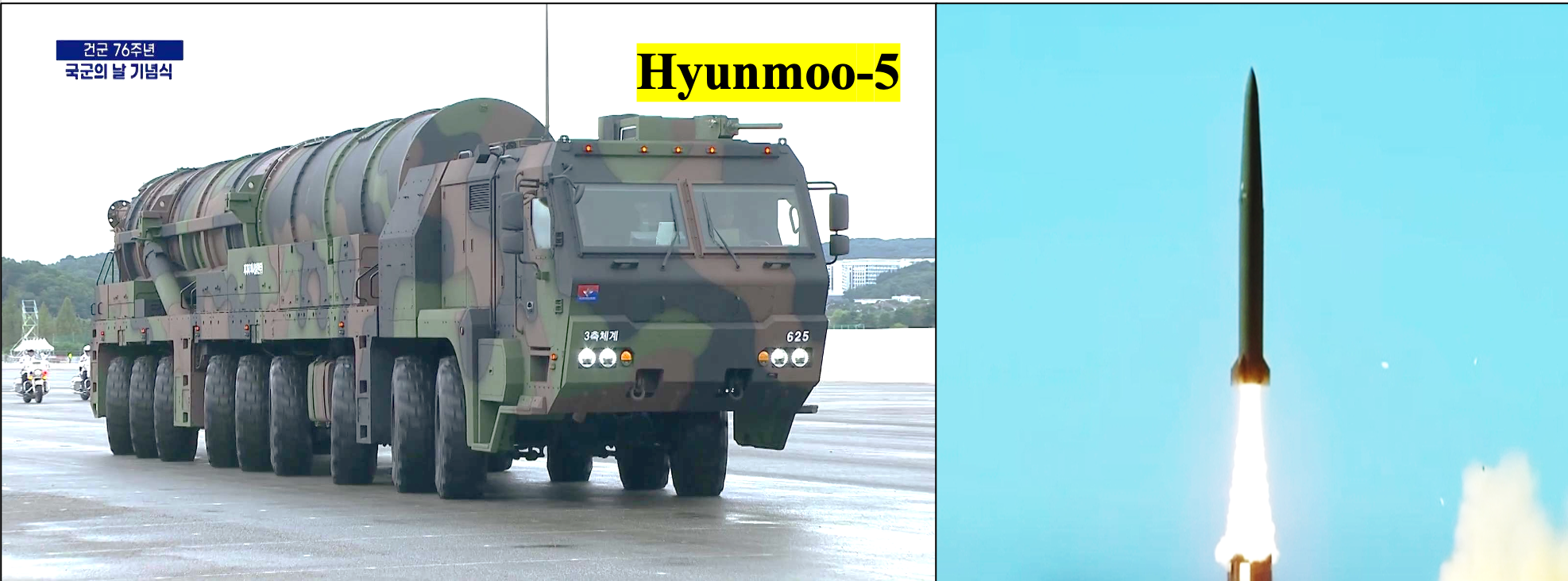
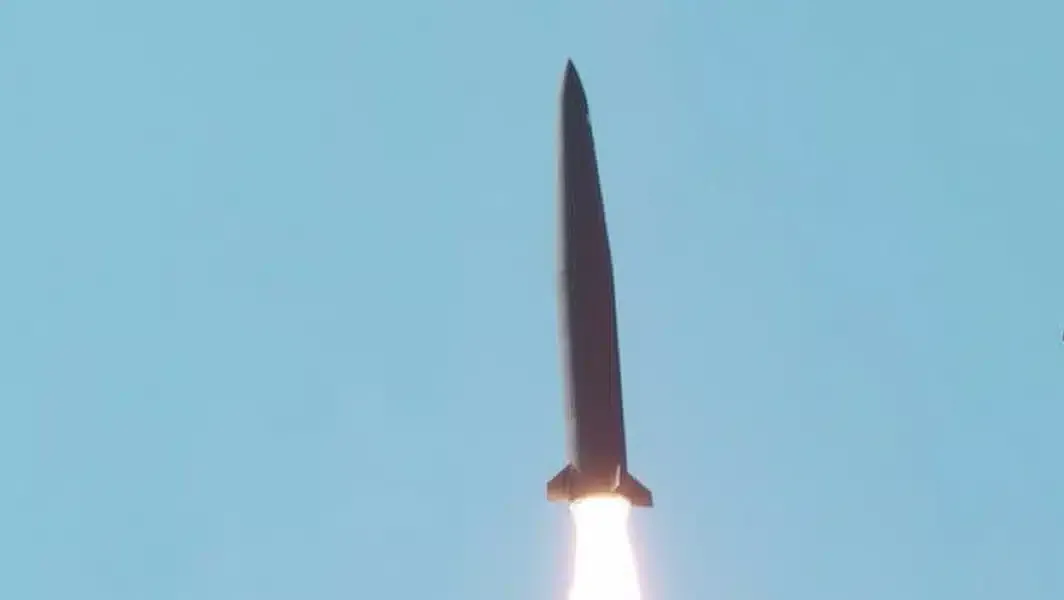
It can reportedly carry an eight-tonne “bunker buster” warhead, potentially able to reach deep underground to destroy heavily fortified bunkers. The missile is understood to be about 16 metres long and is designed as a surface-to-surface missile, capable of being launched from mobile platforms such as trucks and ships. Hyunmoo-5 uses a “cold-launch”, 2 stage solid-fuel system where the missile is ejected vertically from its canister. The main engine ignites after the missile reaches a safe altitude. Its range is said to vary from 600km to more than 5,000km, depending on payload which can vary from 1 to 8 tonnes. It is roughly three times that of the GBU-57 Massive Ordnance Penetrator (MOP) dropped on Iran's Fordow Uranium Enrichment Plant and Natanz Nuclear Facility in June 2025. Its penetrative power is also enhanced by its hypersonic terminal velocity, touted to be in the vicinity of Mach 10. The Hyunmoo-5’s production, which has been contracted to Korean defence prime Hanwha, run at about 70 missiles per year – more than three times that of the GBU-57.
The Hyunmoo-5 officially entered service in 2023, following rigorous testing phases and the plan is to build a total of 200. The missile is expected to be fitted on a future war ship. Israeli analysts estimate a performance range with heaviest warhead to be between 1000 and 3000 km and with light RV: ~ 5000 km. The Israeli analysts found clear indications for “cold launch” and reload of another missile after launch. They added that the Hyunmoo missiles already demonstrated a pin-point impact precision and deep penetration based on high quality GNSS receivers. According to the analysts, the two stages, solid propulsion ballistic missile is equipped with MaRV (Manoeuvring Re-entry Vehicle). Dr Yang Uk, a defence expert at the Asan Institute for Policy Studies in Seoul, said: “We don’t have nuclear weapons, so the only defence we have is to develop the most powerful conventional weapons possible.” A simultaneous launch of 15–20 such missiles is assumed to cause destruction comparable to, or even greater than, the effect of tactical nuclear weapons.
Proposal: A Nordic non-nuclear deterrent force initially based on S-Korean technology
- The idea is to establish a common Nordic non-nuclear deterrent force (“Mjølnir”?) of willing Nordic countries based initially on Hyunmoo-5 missiles. It is assumed that no single Nordic country can pay for or support this deterrence force.
- Other Nato countries could join later. Poland may even be one of the founding fathers
- One basis for this idea is that South Korea already has many military links (e.g. K9 howitzers, K239 Chunmoo missiles) to the Nordic countries and may be willing to sell Hyunmoo-5 missiles to a Nordic coalition. In time also to transfer technology to build/maintain these missiles in Europe.
- The Nordic missile force could be truck- and/or ship-based or some other solutions
- Perhaps a concept based on Norwegian type supply ships for offshore could be a model for the Norwegian ship-based arm, possibly with a main base at Olavsvern. In Sweden the reactivated Muskø Base or other naval bases could be an equivalent. The land-based arm could take advantage of unused hardened aircraft shelters (HAS) in Norway; Andøya (40 shelters), Sola, the COB hangar at Flesland, Rygge, Bodø, Evenes, Bardufoss + or even military add-ons to a few of Norway`s 1260 road tunnels. Other countries will seek their own solutions according to national circumstances.
- This force could be under a central command located in Finland or Sweden. Manufacturing, maintenance and testing sites must also be established.
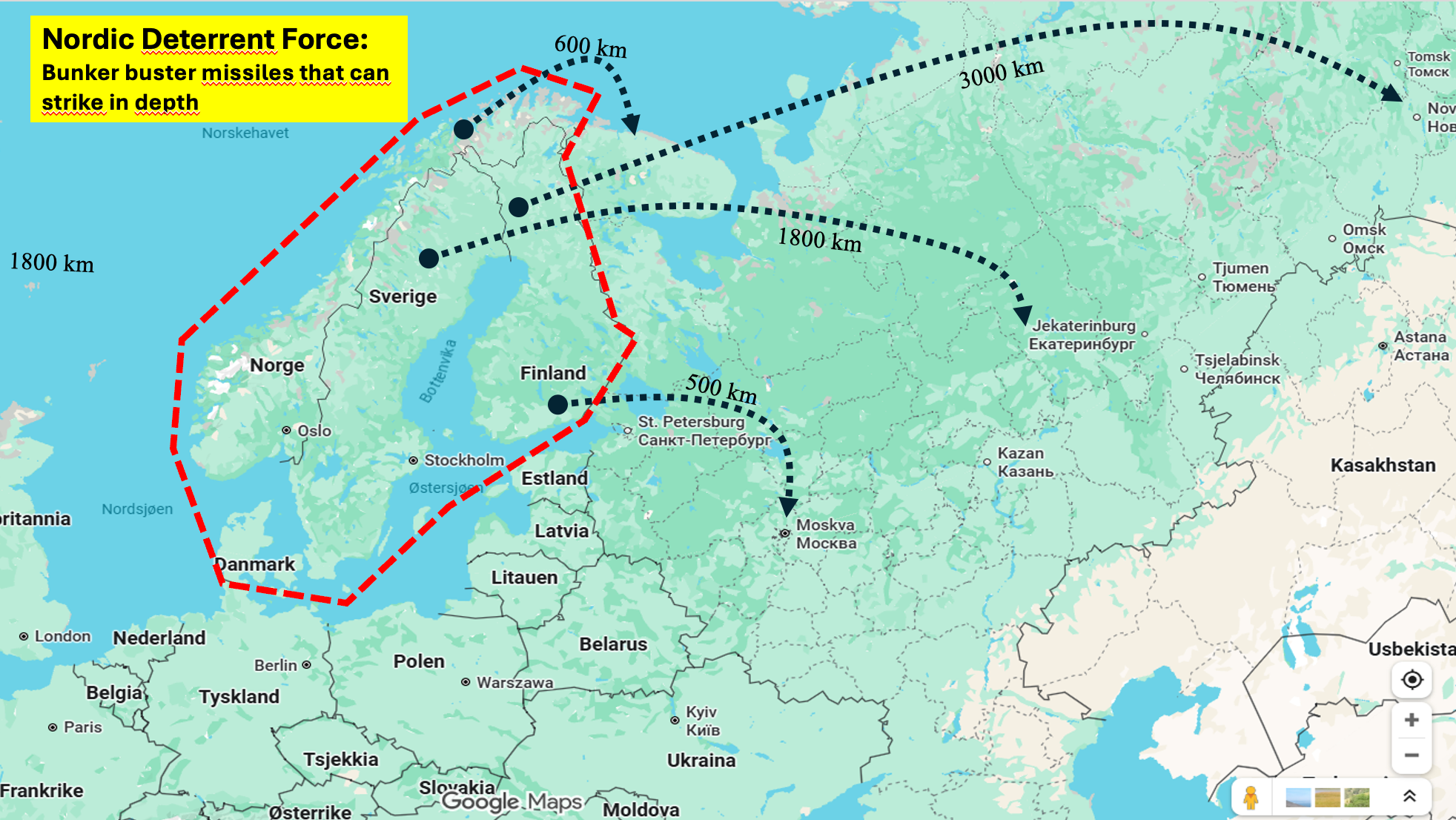
Photo: South Korean Ministry of National Defense